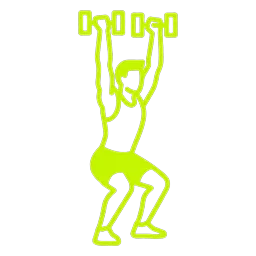
Dumbbell thruster
A highly effective compound exercise that combines a front squat with an overhead press to build explosive full-body power, muscular endurance, and cardiovascular conditioning.
Count your Dumbbell thruster reps with AIFree in your browser — no app, no equipmentHow to Do Dumbbell thruster
- Stand with your feet shoulder-width apart, holding a dumbbell in each hand at shoulder height with your elbows pointed slightly forward.
- Lower your hips back and down into a deep squat, keeping your chest upright and your knees tracking in line with your toes.
- Drive explosively through your heels to return to a standing position, using the upward momentum of your hips to push the dumbbells overhead.
- Fully extend your arms at the top of the movement, locking out your elbows with your biceps close to your ears.
- Lower the dumbbells back to your shoulders in a controlled manner as you simultaneously transition back down into the next squat.
Muscles worked
QuadricepsDeltoidsGlutesTricepsCore
Form tips
- Keep your torso upright and your elbows high during the squat to prevent the dumbbells from pulling your center of gravity forward.
- Ensure the transition between the squat and the press is one continuous, fluid motion to maximize power transfer from your lower body.
- Exhale forcefully as you drive the weights overhead and inhale as you lower them back down.
Common mistakes
- Pausing at the top of the squat before starting the press, which eliminates the momentum and turns it into two separate exercises.
- Allowing your knees to cave inward during the squat phase, which increases the risk of joint injury.
- Arching your lower back at the top of the press instead of keeping your core braced and ribs tucked.
FAQ
How many reps and sets of dumbbell thrusters should I do?
For cardiovascular conditioning and muscular endurance, perform 3 to 4 sets of 12 to 15 reps. For strength and power, aim for 4 sets of 6 to 8 reps using heavier dumbbells.
What is the benefit of using dumbbells instead of a barbell for thrusters?
Dumbbells require more stabilization, help correct muscle imbalances between your left and right sides, and allow for a more natural, neutral grip that can be easier on the wrists and shoulders.
Is the dumbbell thruster a cardio or a strength exercise?
It is both. Because it recruits major muscle groups in both the upper and lower body through a large range of motion, it rapidly elevates your heart rate while building functional strength.