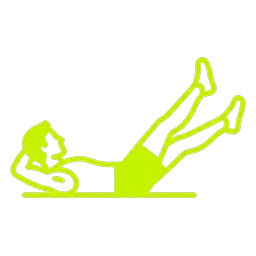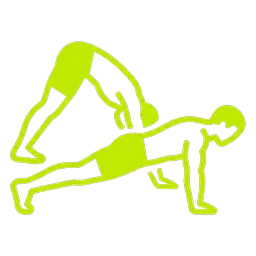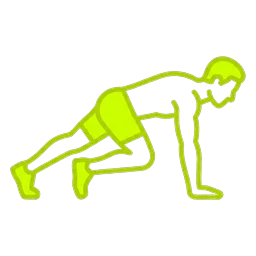
Crawling plank
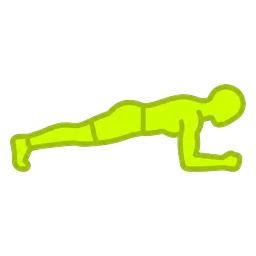
The crawling plank is a dynamic core exercise that requires moving forward and backward while maintaining a forearm plank. It challenges the entire core, shoulder stabilizers, and hip flexors by introducing movement to a static hold.
Count your Crawling plank reps with AIFree in your browser — no app, no equipmentHow to Do Crawling plank
- Start in a standard forearm plank position with your elbows directly under your shoulders, feet hip-width apart, and your body in a straight line.
- Engage your core and glutes, then shift your right elbow and left foot forward a few inches simultaneously.
- Immediately follow by shifting your left elbow and right foot forward to complete the next step.
- Continue crawling forward for the prescribed number of repetitions or distance while keeping your hips level.
- Reverse the pattern by stepping backward with opposite limbs to return to your starting position.
Muscles worked
Rectus abdominisTransverse abdominisAnterior deltoidsObliques
Form tips
- Take small, controlled steps rather than large reaches to prevent your hips from swaying.
- Keep your gaze focused on the floor slightly ahead of your hands to maintain a neutral neck.
- Actively press your forearms into the floor to keep your shoulders engaged and prevent your chest from sagging.
Common mistakes
- Allowing the hips to sag toward the floor, which places excessive stress on the lower back.
- Excessive lateral rocking or twisting of the pelvis while moving the limbs.
- Piking the hips up into the air to make the crawling movement easier.
FAQ
How many reps and sets of crawling planks should I do?
Aim for 3 to 4 sets of 10 to 16 total steps (5 to 8 steps forward and the same number backward) per set, focusing on slow, deliberate movement.
What surfaces are best for performing this exercise?
It is best performed on a soft surface like an exercise mat, turf, or carpet to protect your elbows and toes from friction.
How does this differ from a standard plank?
While a standard plank is an isometric hold, the crawling plank adds a dynamic element that forces your core to stabilize against rotational forces as you move.