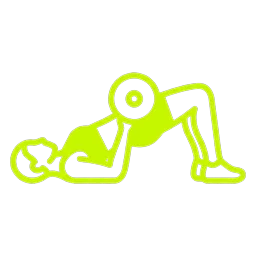
Hip Thrust
An effective lower-body exercise performed by driving the hips upward against resistance while the upper back is supported on a bench, specifically designed to maximize gluteus maximus activation.
Count your Hip Thrust reps with AIFree in your browser — no app, no equipmentHow to Do Hip Thrust
- Sit on the floor with your upper back resting firmly against the edge of a flat bench, placing a padded barbell across your hip crease.
- Position your feet flat on the floor, shoulder-width apart, so that your shins are vertical when your hips are fully raised.
- Grip the barbell securely to stabilize it, then drive through your heels to lift your hips until your thighs and torso are parallel to the floor.
- Squeeze your glutes hard at the top of the movement, keeping your chin tucked and your gaze looking forward.
- Lower your hips back down under control to the starting position, maintaining tension in your glutes.
Muscles worked
Gluteus maximusHamstringsCoreQuadriceps
Form tips
- Keep your chin tucked toward your chest throughout the entire movement to prevent hyperextension of your lower back.
- Ensure your shins form a 90-degree angle with the floor at the top of the movement to optimize glute recruitment.
- Focus on pushing the floor away through your heels rather than pushing off your toes.
Common mistakes
- Arching the lower back at the top of the movement instead of maintaining a neutral spine and tilting the pelvis posteriorly.
- Placing feet too far forward, which shifts the emphasis away from the glutes and onto the hamstrings.
- Rushing the movement and failing to achieve full hip extension at the top of each repetition.
FAQ
How many reps and sets of hip thrusts should I do?
For building strength and muscle mass, perform 3 to 4 sets of 8 to 12 repetitions, focusing on a controlled tempo and a brief pause at the top of each rep.
How do I stop my lower back from hurting during hip thrusts?
Ensure you are not arching your spine at the top of the movement. Keep your ribs down, tuck your chin forward, and focus on driving the movement through pelvic rotation and glute contraction.
What is the difference between a glute bridge and a hip thrust?
A glute bridge is performed flat on the floor, while a hip thrust has the upper back elevated on a bench. The elevation of the hip thrust creates a larger range of motion and allows for heavier loading.