Squat
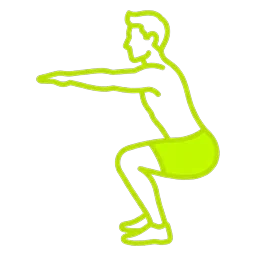
The squat is a fundamental compound lower-body exercise that targets the quadriceps, glutes, and hamstrings to build overall lower-body strength, power, and functional mobility.
Count your Squat reps with AIFree in your browser — no app, no equipmentHow to Do Squat
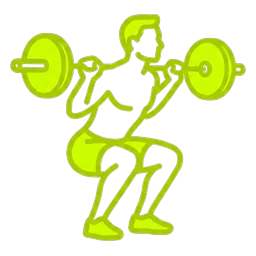
- Set up the barbell on a rack at mid-chest height, step under the bar to rest it across your upper trapezius muscles, and grip it firmly with both hands.
- Unrack the barbell by extending your legs, take one to two steps backward, and set your feet slightly wider than shoulder-width apart with your toes pointed slightly outward.
- Inhale, brace your core, and initiate the movement by pushing your hips back and bending your knees to lower your body.
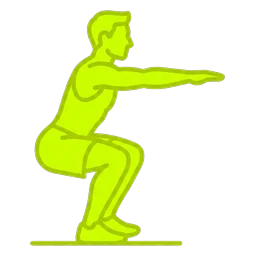
- Descend until your thighs are at least parallel to the floor, keeping your chest up and your spine in a neutral position.
- Drive through your mid-foot to extend your hips and knees, returning to the starting position while exhaling at the top of the movement.
Muscles worked
QuadricepsGluteus MaximusHamstringsCore
Form tips
- Keep your heels planted firmly on the floor throughout the entire movement to maintain balance and optimal power transfer.
- Actively push your knees outward in the direction of your toes as you descend and ascend to prevent them from caving inward.
- Maintain a tight, braced core and a neutral spine to protect your lower back from rounding under the load.
Common mistakes
- Allowing the knees to cave inward (valgus collapse) during the descent or ascent, which places high stress on the knee joints.
- Rounding the lower back at the bottom of the movement, commonly known as a butt wink, which transfers the load to the lumbar spine.
- Shifting weight forward onto the toes, which lifts the heels off the ground and reduces overall stability and power.
FAQ
How deep should I squat?
Aim to lower your hips until they are at least parallel with your knees. If your mobility allows, squatting slightly below parallel is optimal, provided you can maintain a neutral spine.
How many reps and sets of squats should I do?
For general strength, perform 3 to 5 sets of 4 to 6 reps with a heavier weight. For muscle growth (hypertrophy), perform 3 to 4 sets of 8 to 12 reps with a moderate weight.
Is it safe for my knees to go past my toes during a squat?
Yes, it is safe and anatomically necessary for most people, especially those with longer limbs, to let their knees travel past their toes to achieve proper depth while keeping the torso upright.