Unilateral seated row
The unilateral seated row is a single-arm pulling exercise that targets the upper back while correcting strength and muscular imbalances between sides. By working one arm at a time, it allows for a greater range of motion and engages the core to prevent trunk rotation.
Count your Unilateral seated row reps with AIFree in your browser — no app, no equipmentHow to Do Unilateral seated row
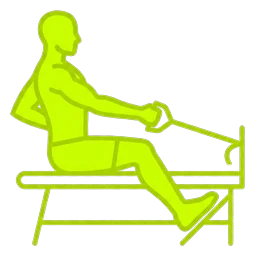
- Sit upright at a cable row station with your feet secured on the footrests and knees slightly bent.
- Grasp a single D-handle attachment with one hand using a neutral grip, extending your arm fully while keeping your shoulders square.
- Brace your core and pull the handle toward your lower ribs by driving your elbow straight back close to your body.
- Squeeze your shoulder blade at the peak of the movement, pausing for a brief second.
- Slowly return the handle to the starting position, maintaining tension in your back and avoiding sudden drops.
Muscles worked
latissimus dorsirhomboidstrapeziusrear deltoidsbiceps
Form tips
- Focus on driving your elbow back rather than pulling with your hand to maximize back engagement.
- Keep your torso completely stationary and square to the machine to prevent momentum from assisting the lift.
- Perform all repetitions on your weaker side first, then match that number of repetitions with your stronger side.
Common mistakes
- Rotating the torso to pull the weight farther back, which reduces back activation and strains the spine.
- Shrugging the shoulder upward toward the ear, which overactivates the upper trapezius and neck.
- Letting the weight pull the arm forward too quickly, losing control during the eccentric phase.
FAQ
How many reps and sets should I do?
For muscle hypertrophy and balance, perform 3 to 4 sets of 8 to 12 controlled repetitions per side.
Can I use a pronated or supinated grip for this exercise?
Yes. A neutral grip is standard, but a pronated (palm down) grip targets more upper back and rear delts, while a supinated (palm up) grip increases biceps involvement.
Why do I feel this exercise in my lower back?
If you feel your lower back, you are likely leaning too far forward or backward during the movement. Keep your spine neutral and your core braced throughout the set.