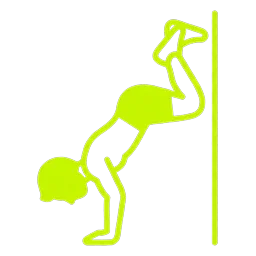
Wall handstand push up
The wall handstand push-up is an advanced bodyweight exercise performed in an inverted position against a wall, designed to build exceptional shoulder strength, triceps power, and upper-body stability.
Count your Wall handstand push up reps with AIFree in your browser — no app, no equipmentHow to Do Wall handstand push up
- Place your hands about 6 to 12 inches away from a wall, slightly wider than shoulder-width apart, with fingers spread wide.
- Kick up into a handstand against the wall, keeping your body straight, heels resting lightly against the wall, and core fully engaged.
- Inhale and slowly lower yourself by bending your elbows until the top of your head lightly touches the floor or a mat.
- Keep your elbows tucked at roughly a 45-degree angle to your torso rather than flaring them out to the sides.
- Exhale and press powerfully through your palms to extend your arms, returning to the starting handstand position.
Muscles worked
ShouldersTricepsUpper ChestTrapeziusCore
Form tips
- Maintain a tight hollow-body position by squeezing your glutes and bracing your core to prevent excessive arching in your lower back.
- Keep your gaze neutral or slightly toward the wall rather than looking straight down at the floor, which can strain your neck.
- Place a small yoga block or folded mat under your head to safely reduce the range of motion if you are transitioning to this movement.
Common mistakes
- Flaring the elbows out to 90 degrees, which places excessive, unsafe stress on the shoulder joints.
- Arching the lower back excessively, also known as banana back, which compromises core stability and spine alignment.
- Descending too quickly without control, which risks head injury and reduces muscle tension.
FAQ
How many reps and sets of wall handstand push-ups should I do?
For strength and skill development, perform 3 to 5 sets of 3 to 8 controlled repetitions, resting 2 to 3 minutes between sets.
What if I cannot perform a full wall handstand push-up yet?
Regress the movement by practicing pike push-ups, elevated pike push-ups, or handstand holds against the wall to build the necessary baseline strength.
Should my back face the wall or should I face the wall?
Back-to-wall is easier to kick up into and is the standard variation, while chest-to-wall encourages better shoulder alignment and hollow-body form but requires walking your feet up the wall.