Wall squat
The wall squat is a lower-body exercise that builds isometric strength and endurance in the quadriceps, glutes, and calves. It is highly effective for improving knee stability and leg strength with minimal joint impact.
Count your Wall squat reps with AIFree in your browser — no app, no equipmentHow to Do Wall squat
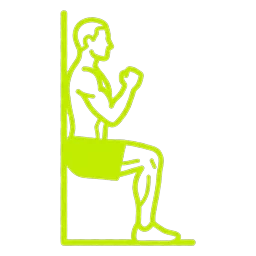
- Stand with your head, shoulders, and back flat against a smooth wall, with your feet positioned about two feet away from the wall.
- Step your feet shoulder-width apart, pointing your toes slightly outward.
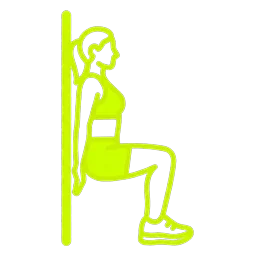
- Slowly slide your back down the wall by bending your knees until your thighs are parallel to the floor.
- Adjust your feet so that your knees are directly above your ankles, forming a 90-degree angle at both your hips and knees.
- Hold this position for the designated time, keeping your core engaged and your back flat against the wall.
- Push through your heels to slide back up the wall to the starting position.
Muscles worked
Form tips
- Keep your weight distributed through your heels rather than your toes to protect your knees.
- Ensure your lower back remains pressed firmly against the wall to prevent hyperextension of the lumbar spine.
- Keep your hands resting on your thighs or extended straight out in front of you; do not use them to push against the wall or your knees for support.
Common mistakes
- Allowing the knees to cave inward toward each other, which places dangerous lateral stress on the knee joints.
- Positioning the feet too close to the wall, causing the knees to protrude far past the toes and increasing patellofemoral pressure.
- Letting the lower back arch away from the wall, which transfers the workload away from the legs and onto the spine.
FAQ
How many reps and sets of wall squats should I do?
For strength and endurance, perform 3 to 4 sets of 12 to 15 controlled repetitions (sliding up and down), or complete 3 to 4 sets of isometric holds lasting 30 to 60 seconds each.
What should I do if I feel knee pain during the wall squat?
If you experience knee pain, slide slightly higher up the wall to reduce the knee angle to 45 or 60 degrees instead of 90 degrees, and ensure your knees are not tracking past your toes.
How can I make the wall squat more challenging?
You can increase the intensity by holding a dumbbell in each hand, placing a medicine ball between your knees to engage the inner thighs, or performing the exercise on a single leg.